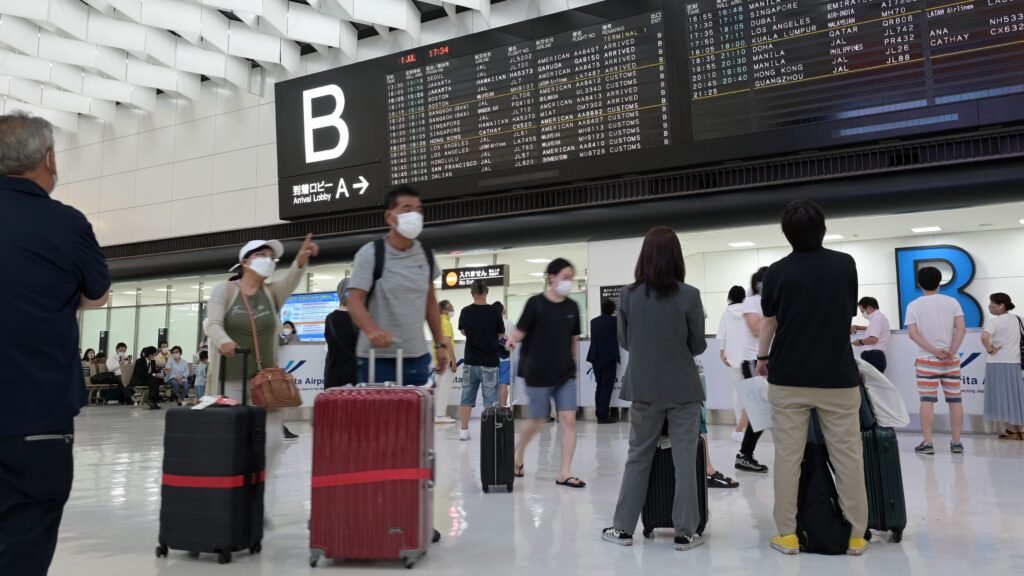
A modest trickle of foreign visitors are now entering Japan as a result of the country’s loosened border controls, which is a depressing but not unexpected development given the sector’s protracted struggles.
According to industry sources, Japan’s remaining entrance requirements regarding PCR tests and chaperoned travel packages deter visitors. Some people pointed out that the COVID-19 epidemic is still present.
Japan continues to impose severe regulations, according to a representative of the Tokyo-based inbound travel operator TAS Co. Despite claiming to be a tourism powerhouse, it is falling behind other nations in welcoming visitors.
After the government relaxed the prohibition on foreign tourists in June, less than 8,000 tourists from other countries visited Japan in the previous month.
The Kuromon Market, an arcade filled with fish shops and restaurants in the Minami section of Osaka, was noticeably devoid of foreign tourists.
The street was constantly crowded with foreign tourists before the COVID-19 outbreak.
According to Kazuo Hata, head of the business that runs the Minami restaurant that specializes in blowfish dishes, “people from Hong Kong and Taiwan were among our very nice clients, and I was grateful.” But as of right now, hardly nobody has come back from there.
An employee at the market-area restaurant Funasada, famous for its grilled eel and oysters, said he didn’t anticipate many repeat customers.
The sharp increase in new COVID-19 cases in Japan, he claimed, “cannot even be contained by the government.” “How can we expect Chinese visitors to this nation when their government has a ‘zero-COVID’ policy in place? ”
On June 10, Japan resumed taking foreign visitors for the first time in the previous two years. The participants must originate from nations and areas where the virus situation is under control, according to one rule.
Japan has had its worst infection rates since July, thanks to a highly contagious Omicron subvariant.
According to a TAS representative, in July, the company organized group excursions for roughly 200 tourists from Singapore, Thailand, and other countries.
The amount is 10% less than it was in the same month in 2019.
The official claimed that one significant disadvantage is that Japan only permits visitors to enter the country as part of supervised group excursions, not as independent tourists.
Therefore, travelers who like to create their own itineraries are choosing South Korea, Thailand, and Europe, instead of Japan,