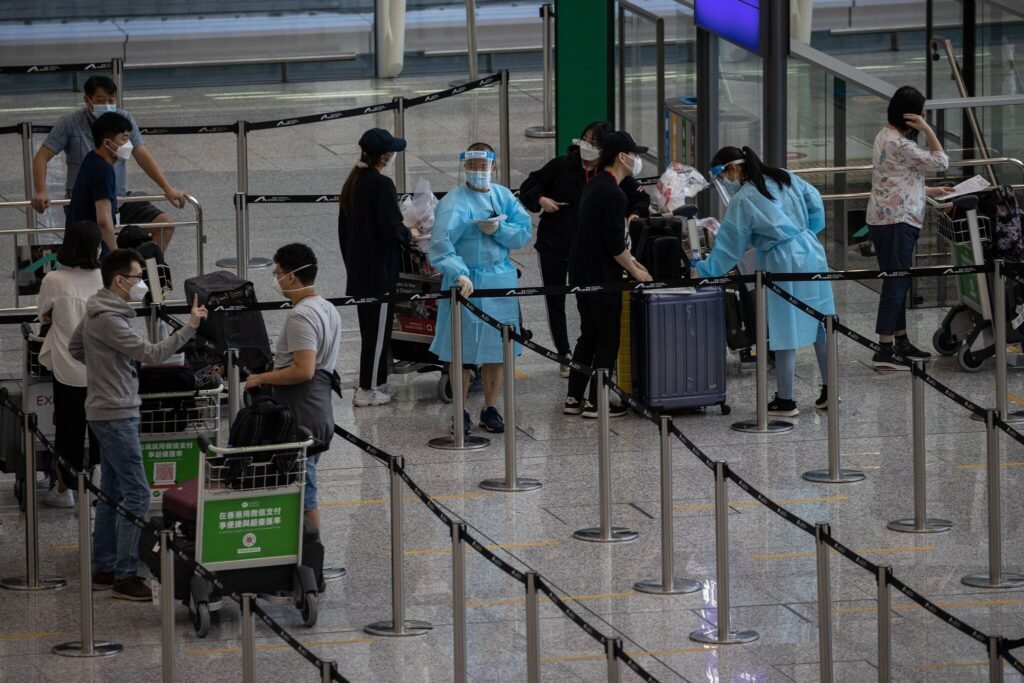
Hong Kong will abandon its strict hotel quarantine policy for arriving travelers, which has damaged the city’s reputation as a financial center, hurt its economy, and caused a resident exodus.
The rule had been in existence for two and a half years, essentially isolating the city from the rest of the world as well as from mainland China, at one time requiring visitors and residents to quarantine at a hotel for as long as three weeks.
The quarantine requirement will be lifted starting on Monday, according to John Lee, the city’s top executive, although travelers will still be tested and monitored for three days after arrival.
“We must allow the maximum room to allow connectivity with the world so that we can have economic momentum, and to reduce inconvenience to arriving travellers,” Lee said on Friday.
Although it has avoided the tight lockdowns that have paralyzed Chinese megacities, Hong Kong has to adhere to a variant of Beijing’s oppressive zero-Covid-19 policy.
However, following a disastrous wave of the Omicron variety that tore through the city and a shift in leadership, the government has gradually lifted regulations. Travelers currently have to spend three days at a hotel.
Friday’s statement came after a lot of pressure from the local and international business sector.
The policy change also precedes a big financial forum and the return of the Rugby Sevens tournament in early November. City leaders hope the events will attract business back to the Chinese territory.
On Tuesday, Beijing seemed to give Hong Kong authorities permission to loosen border controls. It would be “understandable,” according to Huang Liuquan, the deputy chairman of the State Council’s Office for Hong Kong and Macau Affairs, if the limits were relaxed.
If a passenger’s initial test is positive, they must isolate at home, at a hotel, or in a community isolation center.
Travelers will be permitted to self-monitor for three days and will no longer be required to perform a PCR test 48 hours before landing in Hong Kong. But throughout that time, they’ll still be prohibited from going to pubs and restaurants.
Additionally, they must submit to PCR testing at Hong Kong International Airport, on Days 2, 4, and 6 following their arrival, as well as daily RAT tests for a week.
The three days of surveillance and additional entry procedures may still hinder the return of visitors and entrepreneurs notwithstanding the adjustment.
Chinese authorities agreed last month to let travelers undergo required isolation in quarantine facilities in Hong Kong before traveling to the mainland. However, more steps to ease border crossings have yet to be disclosed.
Following first- and second-quarter GDP declines of 3.9% and 1.4%, respectively, Hong Kong was obliged to lower its growth prediction for 2022 to between minus 0.5% and 0.5% last month.
Since the start of the epidemic, the city has registered a total of 1.7 million cases and 9,900 fatalities.
Large enterprises and financial institutions shifted employees and operations from Hong Kong to the city-state as a result of the Covid regulations, strengthening Singapore’s position as a regional center.
The implementation of a comprehensive national security law by Beijing in 2020 that severely restricted civil society alarmed many people of Hong Kong as well. More than 120,000 people have left the 7.3 million-person city this year.