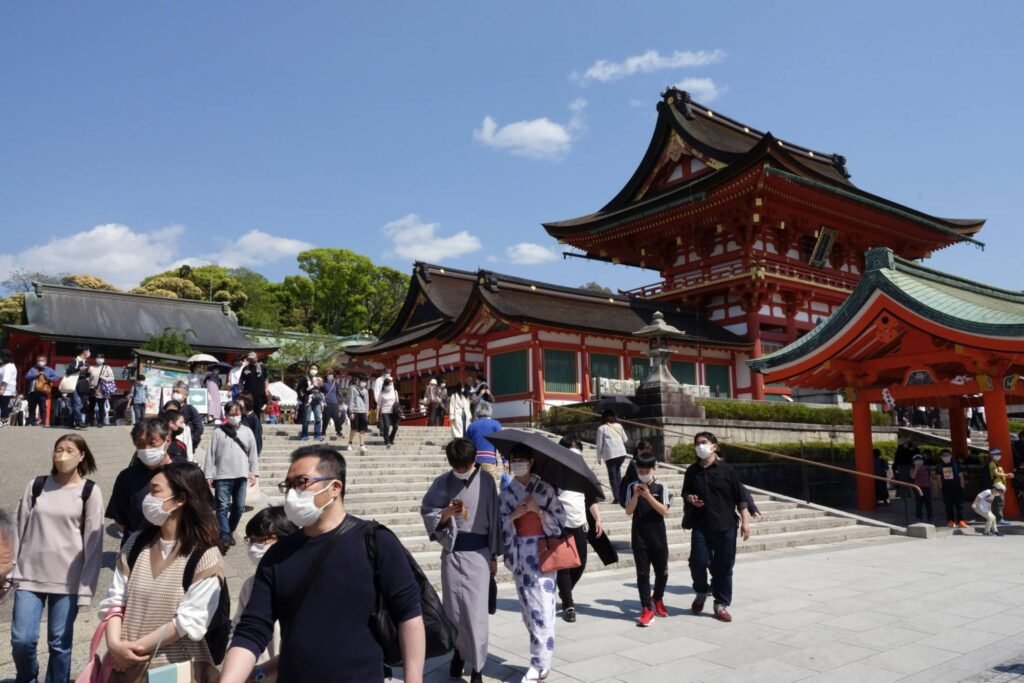
To promote its still-restricted international tourism, Japan increased its daily arrivals entrance threshold on Wednesday to 50,000 and removed the requirement for tour guides for foreign visitors.
At a news conference, government spokesperson Hirokazu Matsuno stated that the new legislation is intended to let Japan participate in foreign exchanges while still achieving a balance between Covid-19 prevention efforts and socioeconomic activities.
According to Matsuno, the government would adjust its policies in light of the prevalence of illnesses both domestically and overseas as well as other nations that have strong relations to the archipelago.
Since June, Japan has permitted the entry of foreign tourists on group tours planned and overseen by a tour guide within the parameters of its 20,000 authorized daily entries. However, as of right now, neither a guide nor a specific tour booking will be required, though it will be necessary to present an advance travel itinerary.
Although it has not been made clear what particular factors would decide if this sort of tourism is viable, a mediating travel agency will still be required to handle the visit and get a document essential for processing the visa.
Beginning on Wednesday, travelers who have received three or more doses of the vaccination will not be required to show proof of a negative PCR test conducted within 72 hours of their departure for Japan.
The previous day, Prime Minister Fumio Kishida declared that he would reduce the existing 10-day Covid-19 isolation requirement for patients to seven days beginning on the day they begin to exhibit symptoms.
Since then, it has been essential to get a visa in order to enter Japan, especially for tourism-related activities. This is because Japan discontinued its visa exemption for short-term stays (up to three months) that it maintained with 68 countries as a result of the epidemic.
The primary barrier preventing visitors from visiting the archipelago is Japan’s stringent border controls. Japan welcomed 31.9 million tourists in 2019, while 246,000 people visited in 2021, according to information from the National Tourism Office.