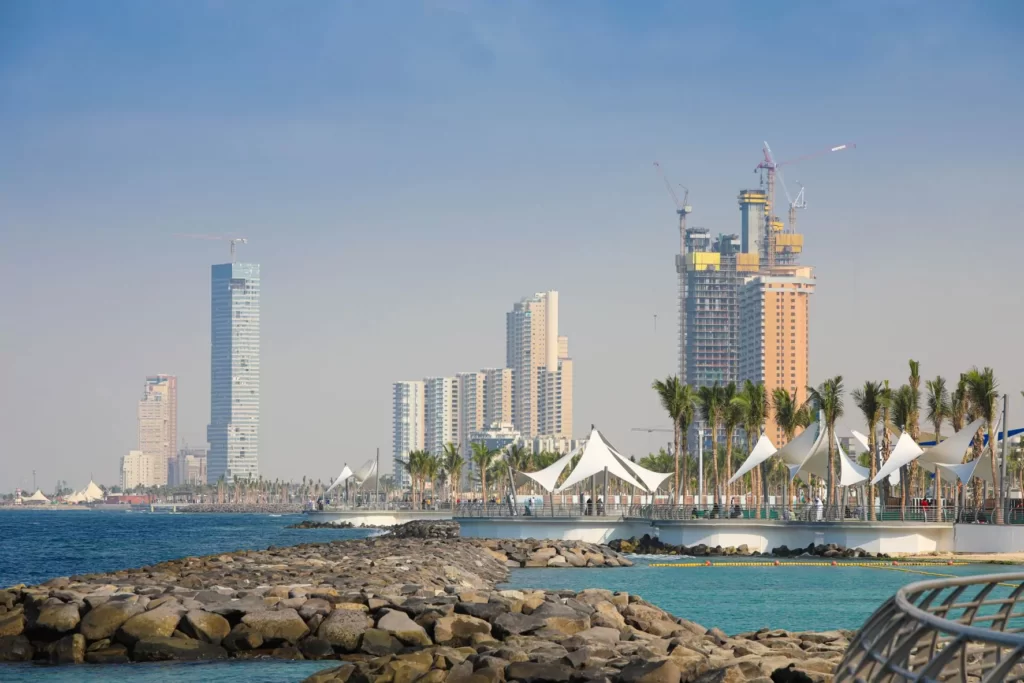
Jeddah is made up of well over a hundred districts that are dispersed inland toward Mecca and along the Red Sea coast. King Abdul Aziz Street, the city’s primary north-south axis, spans from Old Jeddah in the southern end of the city and is filled with banks, stores, and restaurants. The city gradually becomes more contemporary as it stretches along Medina Road far to the north of Al-Balad, although slums border the city’s north, east, and notably its southern edge. Al-Andalus Street, another important north-south route, runs parallel to Medina Road’s west side, while the Corniche (Al-Kournaish Road) extends far to the north, from Jeddah Islamic Port to the ever-expanding northern fringes of town. The center of Jeddah’s shopping scene can be found on the glittering midtown Tahlia Street, while the central business sector spans east-west along King Abdullah Street.
Al-Balad
The ancient, cramped buildings of Al-Balad, which make up Jeddah’s historic centre, are located to the southwest of the contemporary city. Some of Jeddah’s major tourist attractions are the city’s Red Sea coral houses, which may reach five storeys high and feature hefty teak wood entrances, ornate wooden rowasheen (balconies), and mashrabiyya (lattice work). Some of these homes have views of Al-Arbaeen Lagoon. Al-Balad, which formerly had a wall around it and six watchtowers, is today distinguished from the nearby metropolis by its winding alleyways flanked by ancient Hejazi buildings and lively souqs. While many of the city’s mosques and markets are still operational, three of the historic city gates—Baba Makkah, Bab Sharif, and the North Gate—have been rebuilt. The main market in Al-Balad, Souq Al-Alawi, is among the most well-known of them. Other notable ones are Souq Al-Nada, Souq Al-Jami’, Souq Al-Bado, and Souq Gabel, as well as the Al-Shafi’i Mosque with its 13th-century minarets.
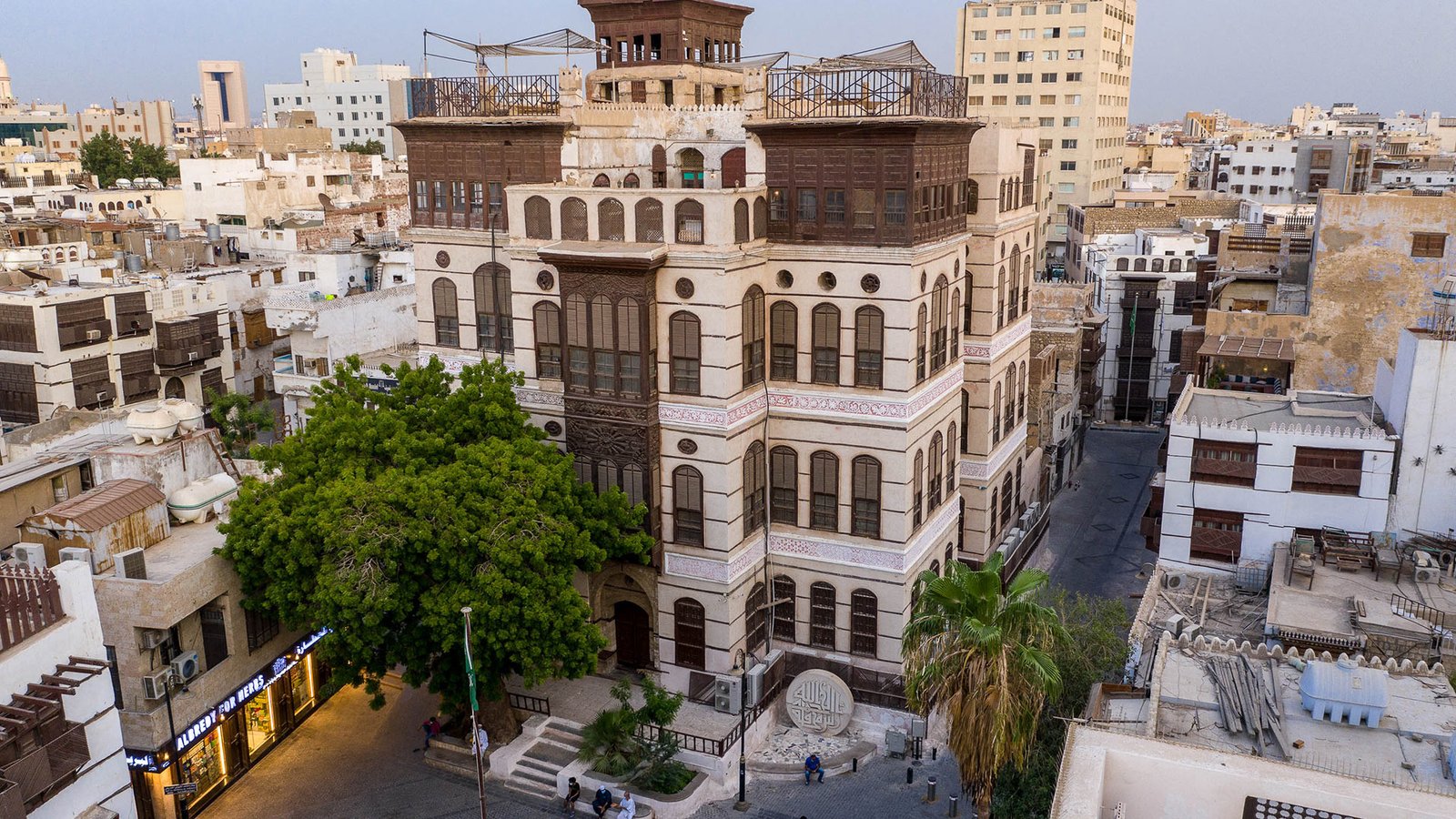
Al-Balad souq’s are among the liveliest and most colorful in the entire Kingdom because local shoppers are joined by a varied range of pilgrims and visitors. Visitors to Al-Balad may also be interested in the lavish residences of affluent 19th-century merchants such the Naseef House and Shorbatly House. While the latter has been expertly restored to its former splendour, the latter, like many of Al-abandoned Balad’s structures, is in a condition of decay. The Historical Area Preservation Department launched a significant rehabilitation project in 1990 that is still ongoing, employing more over 50 people to preserve Al-rich Balad’s Hijazi legacy.
King Abdullah Street
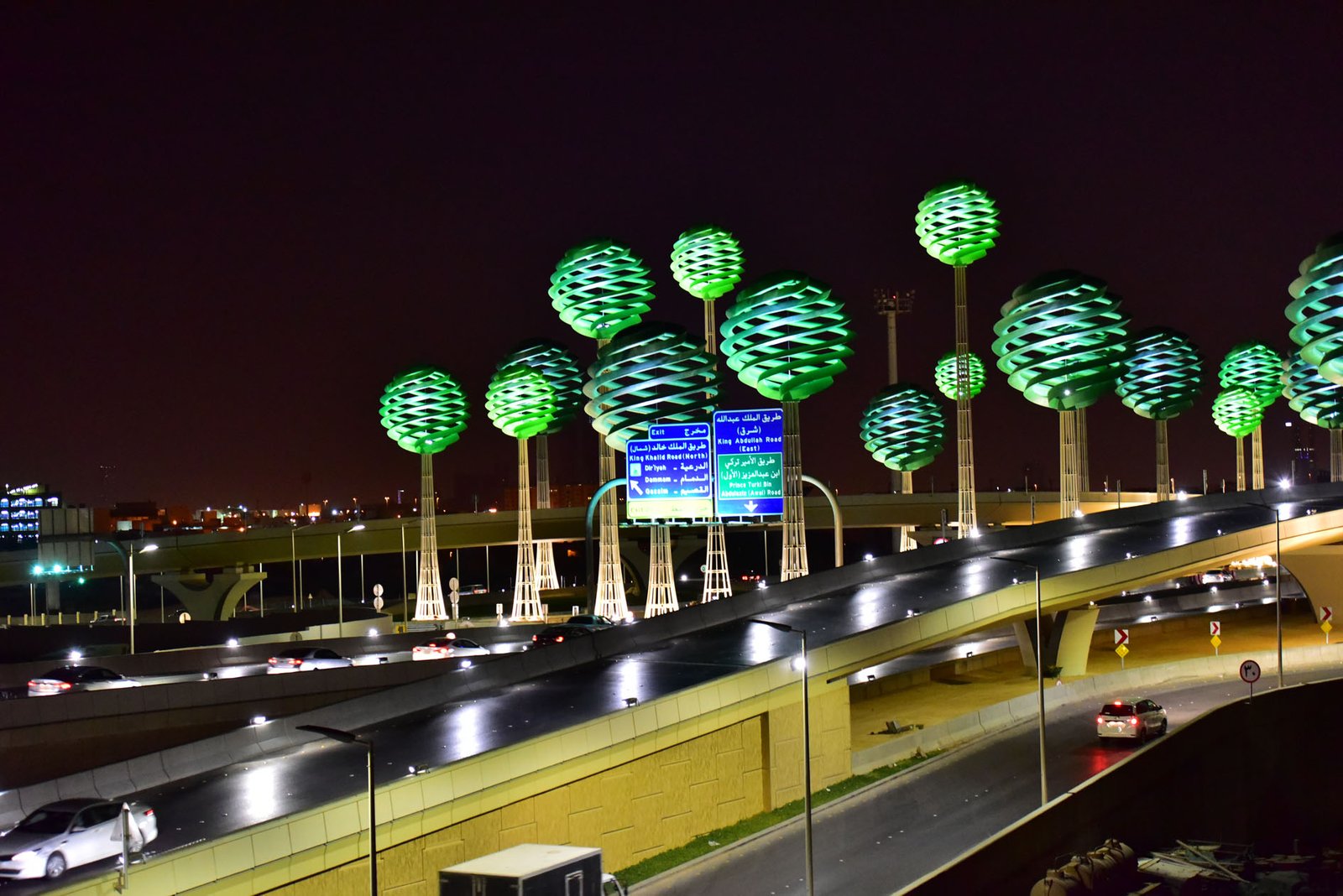
Along King Abdullah Street, which extends from King Fahd Road along the western shore to the eastern edge of the city, is where the majority of the city’s businesses and commerce are located. The area is home to a large number of business establishments, the global headquarters of organizations, banks, and conglomerates, including the influential Emaar Middle East and Al-Farsi, the International Islamic News Agency, the International Association of Islamic Banks, and the National Commercial Bank.
Tahlia Street
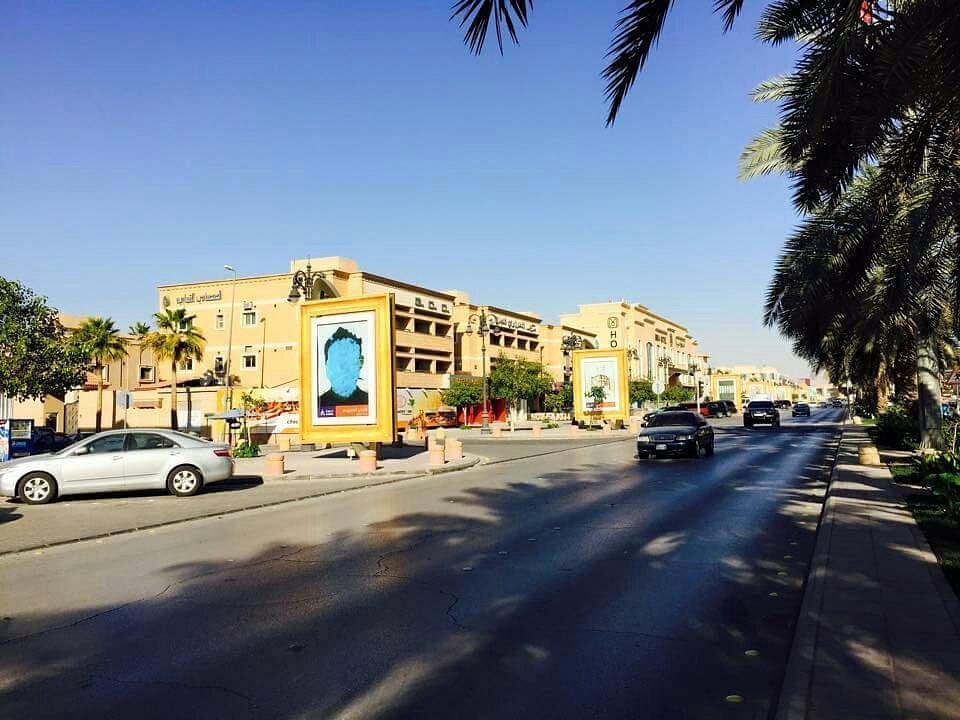
Tahlia Street, Jeddah’s flashiest neighborhood, is home to the majority of the city’s wealthy residents. The Jeddawi elite go there to shop since it is crowded with malls, expensive department shops, and upmarket boutiques. Prada, Chanel, Gucci, Louis Vuitton, Ralph Lauren, Giorgio Armani, and Dolce & Gabbana are just a few of the brands with stores there. Additionally, it conducts periodic drag races as well as victory celebrations following Saudi football games.